


A successful new fruit tree plantation starts with proper planting and consistent care during the first three years. Many fruit trees struggle after transplanting because their roots fail to establish properly. Weak roots often lead to slow growth, yellow leaves, poor flowering, and lower fruit production in the future.
The first three years are the foundation of a healthy fruit tree. During this period, the tree develops its root system, adapts to its new environment, and builds the strength needed for long-term growth and productivity.
By following the right soil preparation, root protection, watering, mulching, and nutrition program, growers can significantly improve tree survival and future yields.
Why the First Three Years Are Important
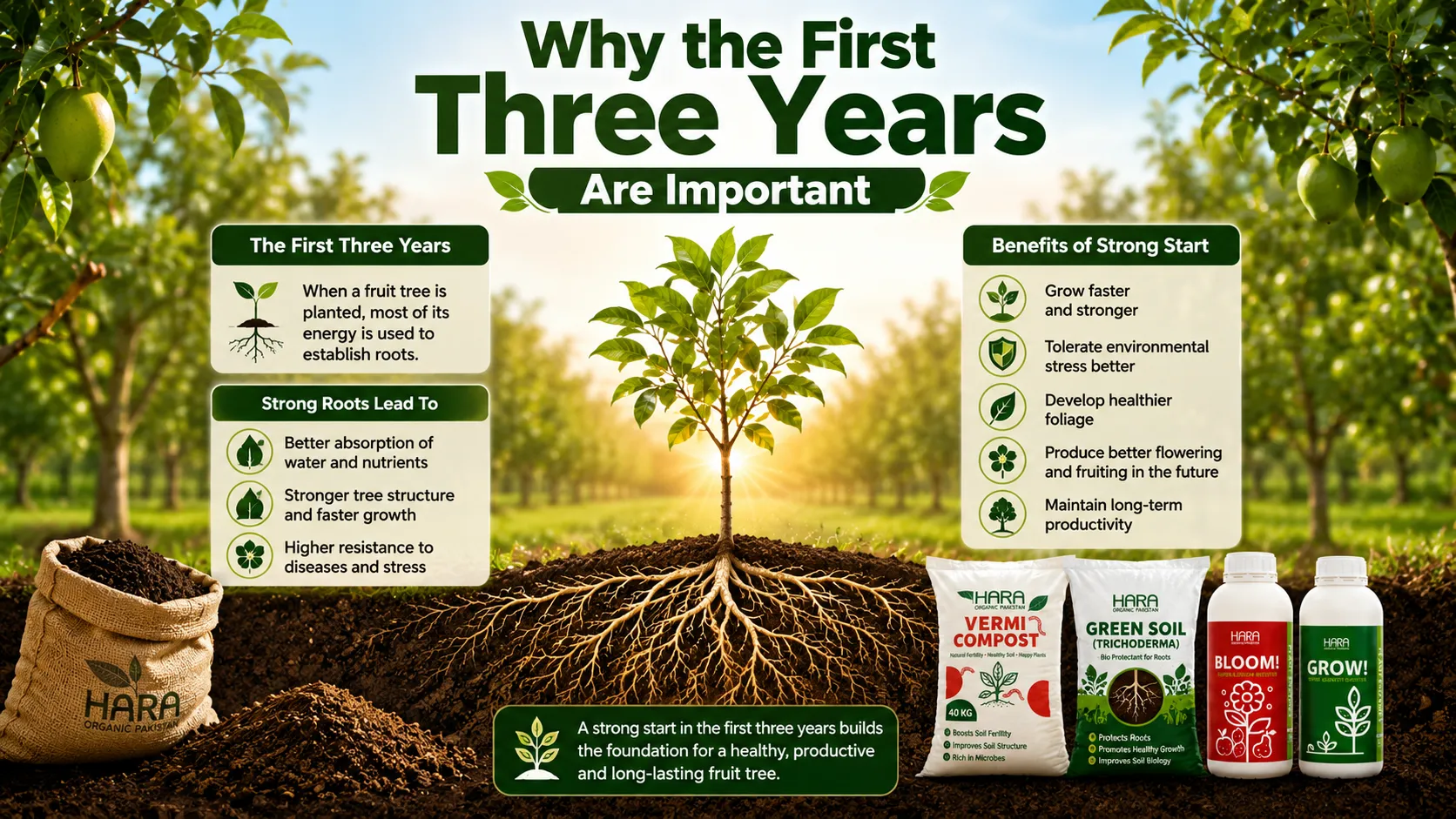
When a fruit tree is planted, most of its energy is directed toward root development. A strong root system allows the tree to absorb water, nutrients, and oxygen more efficiently.
Healthy roots help the tree:
- Grow faster and stronger
- Tolerate environmental stress better
- Develop healthier foliage
- Produce better flowering and fruiting in the future
- Maintain long-term productivity
A tree with a strong root system will always perform better than a tree that receives excessive fertilizer without proper root establishment.
Step 1: Soil Preparation for New Fruit Tree Plantation
Good soil preparation is one of the most important factors for successful tree establishment. Prepare the planting soil using the following mixture:
Material | Recommended Ratio |
Existing Garden Soil | 70% |
Hara Vermicompost | 30% |
Mix thoroughly and use this blend to fill the planting pit around the root ball.
Benefits of Hara Vermicompost
- Improves soil structure
- Increases water holding capacity
- Supports beneficial soil microorganisms
- Encourages faster root growth
- Helps reduce transplant shock
- Improves overall soil fertility
Healthy soil creates the ideal environment for root expansion and tree establishment.
Step 2: Root Protection During Planting
Root diseases are one of the most common reasons for failure in a new fruit tree plantation. Protecting roots during planting greatly increases transplant success.
Use:
Hara Green Soil (Trichoderma)
Apply Hara Green Soil inside the planting pit or mix it into the soil surrounding the roots during planting.
Benefits of Hara Green Soil (Trichoderma)
- Protects roots from fungal diseases
- Reduces the risk of root rot
- Encourages healthy root development
- Improves transplant survival
- Enhances beneficial soil biology
- Supports long-term root health
Applying Trichoderma at planting time helps create a healthy and protected root zone.
Step 3: Annual Root Zone Care
Even after successful establishment, roots need ongoing biological protection.
Apply:
Hara Green Soil (Trichoderma)
around the root zone once every year.
This annual application helps maintain a healthy soil ecosystem and protects roots from disease-causing organisms.
Benefits of Annual Root Zone Treatment
- Maintains healthy soil biology
- Supports stronger root systems
- Improves disease resistance
- Enhances nutrient uptake
- Promotes long-term tree health
- Supports sustainable growth
This simple yearly practice can significantly improve tree performance over time.
Step 4: Proper Watering Practices
Proper watering is essential during the establishment stage of a new fruit tree plantation. Young trees need regular moisture, but excessive watering can be harmful. The soil should remain evenly moist without becoming waterlogged.
Important Watering Rule
Always water away from the stem. Never pour water directly against the trunk. This simple practice helps prevent:
- Stem rot
- Fungal infections
- Root collar damage
- Weak trunk development
- Excess moisture around the stem
Deep watering also encourages roots to grow deeper into the soil, making trees more resilient during dry periods.
Step 5: Mulching Around Young Trees
Mulching is one of the easiest and most effective methods for improving tree health. Apply mulch around the tree using organic materials such as dry leaves, straw, grass clippings, or organic mulch. Keep the mulch slightly away from the trunk to avoid excess moisture buildup.
Benefits of Mulching
- Conserves soil moisture
- Protects roots from extreme temperatures
- Reduces water stress
- Suppresses weed growth
- Improves soil health over time
- Supports beneficial microorganisms
- Reduces evaporation losses
Proper mulching helps young trees establish faster and grow more vigorously.
Step 6: Nutrition Program Every Three Months
Regular nutrition is necessary for continuous growth and healthy development.
Soil Feeding with Hara Veggie Mix
Apply Hara Veggie Mix around the root zone every three months.
Recommended dosage:
- Small Tree – 100 gm
- Medium Tree – 200 gm
- Large Young Tree – 300 gm
After application, lightly mix the product into the soil and water thoroughly.
Benefits of Hara Veggie Mix
- Supports healthy root growth
- Encourages strong branches
- Improves leaf development
- Enhances overall plant vigor
- Promotes balanced growth
- Improves nutrient availability
Regular soil feeding helps maintain healthy growth throughout the year.
Foliar Feeding with Hara Grow
On the same day as the soil application, spray with Hara Grow:
Hara Grow
Dosage:
- 10 ml per 1 liter of water
Spray evenly on the leaves during the cooler part of the day.
Benefits of Hara Grow
- Promotes healthy green foliage
- Supports rapid vegetative growth
- Improves stress recovery
- Encourages faster development
- Increases plant vigor
- Supports overall tree performance
Foliar nutrition provides nutrients directly through the leaves and complements soil feeding.
Ongoing Maintenance Schedule
For best results, follow a consistent care routine throughout the year.
Every Three Months
- Apply Hara Veggie Mix around the root zone
- Spray Hara Grow on the foliage
Once Every Year
- Apply Hara Green Soil (Trichoderma) around the root zone
Regular Maintenance
- Maintain mulch around the tree base
- Water away from the trunk
- Monitor soil moisture regularly
- Check tree health and growth progress
Consistent care helps young trees establish faster and become more productive in later years.
Common Problems in New Fruit Tree Plantation
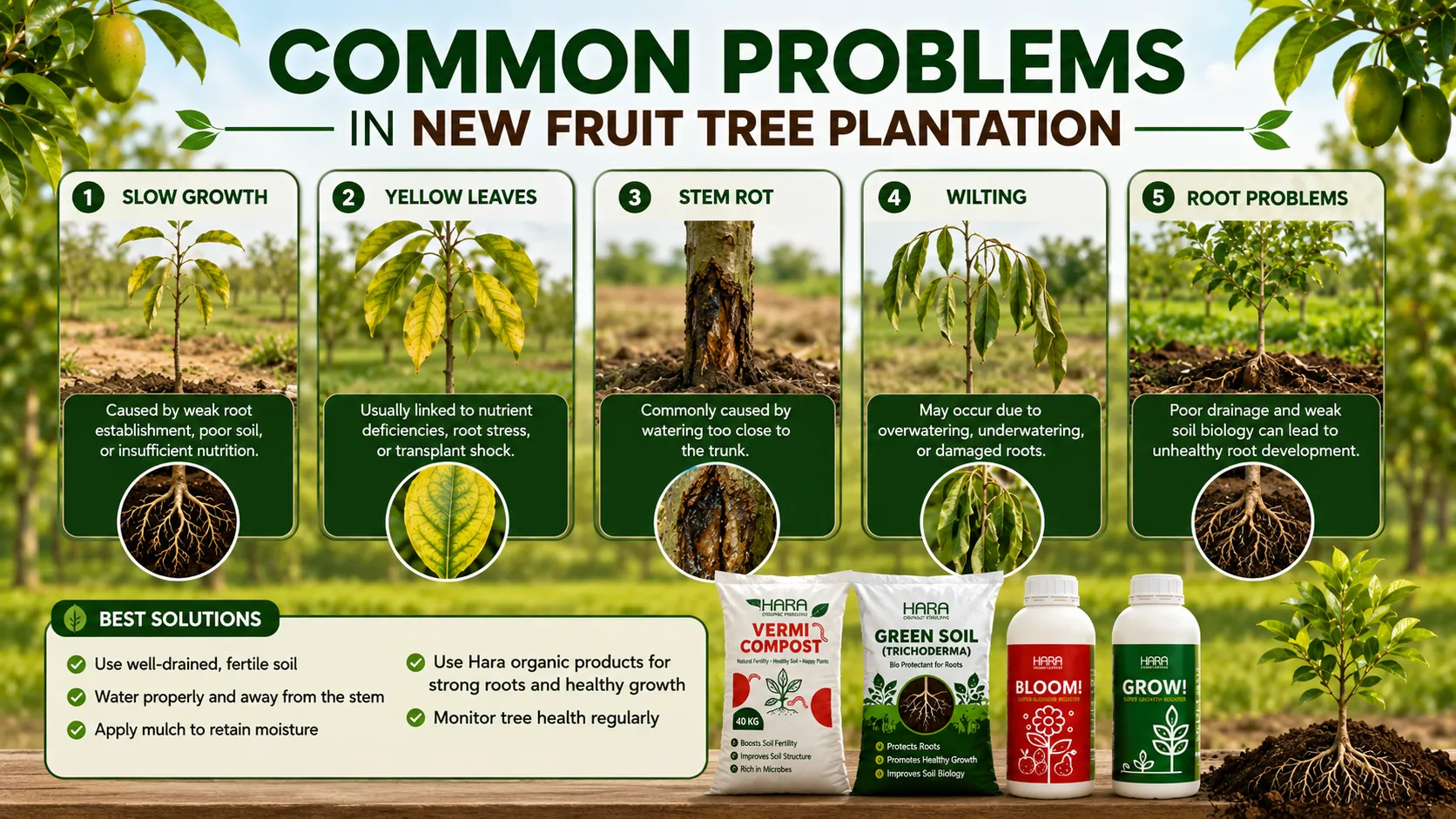
Slow Growth
Often caused by poor root establishment, compacted soil, or inadequate nutrition.
Yellow Leaves
Usually linked to nutrient deficiencies, root stress, or transplant shock.
Stem Rot
Commonly caused by watering too close to the trunk.
Wilting
May occur due to overwatering, underwatering, or root damage.
Root Problems
Poor drainage and weak soil biology can lead to unhealthy root development.
Early identification and correction of these problems can prevent long-term damage.
Expected Results with Proper Management
When a new fruit tree plantation is managed correctly, trees can develop:
- Strong and healthy roots
- Faster and more uniform growth
- Healthy green foliage
- Better establishment after transplanting
- Improved stress tolerance
- Enhanced flowering potential
- Better fruit production in the future
- Greater long-term productivity
Healthy trees established during the first three years usually require less corrective management and produce better results throughout their lifespan.
FAQs: New Fruit Tree Plantation
What is the most important factor in a new fruit tree plantation?
The most important factor in a new fruit tree plantation is strong root establishment during the first three years. Healthy roots help the tree absorb water and nutrients efficiently, leading to faster growth and better future fruit production.
How often should I apply Hara Veggie Mix to young fruit trees?
Hara Veggie Mix should be applied every three months around the root zone. Regular applications help support healthy roots, strong branches, and vigorous tree growth.
Why is Hara Green Soil (Trichoderma) recommended during planting?
Hara Green Soil (Trichoderma) helps protect roots from fungal diseases, reduces the risk of root rot, and improves transplant success. It also promotes beneficial soil biology and healthy root development.
How should I water newly planted fruit trees?
Newly planted fruit trees should be watered deeply and evenly to keep the soil moist. Water should always be applied away from the trunk to prevent stem rot, fungal infections, and root collar damage.
Why is mulching important for young fruit trees?
Mulching helps conserve soil moisture, regulate soil temperature, reduce plant stress, suppress weeds, and improve soil health. Proper mulching supports stronger root growth and better tree establishment.
Conclusion
A successful new fruit tree plantation depends on proper soil preparation, root protection, balanced nutrition, correct watering, and regular maintenance.
Using Hara Vermicompost during planting, Hara Green Soil (Trichoderma) for root protection, Hara Veggie Mix for soil nutrition, and Hara Grow for foliar feeding helps create ideal conditions for healthy tree establishment and long-term productivity.
By following this complete tree care program during the first three years, growers can develop stronger root systems, healthier foliage, improved disease resistance, and better flowering and fruiting potential in the future. For free guidance and consultation, contact Hara Organic Pakistan.




Chemical Free Farming Pakistan: A Practical Guide for Healthier Crops and Sustainable Agriculture
Jump To Chemical Free Farming Pakistan: A Practical Guide for

Organic Cotton Farming Pakistan: A Complete Guide to Sustainable Cotton Production
Jump To Organic Cotton Farming Pakistan: A Complete Guide to

Green Soil Plant Growth: A Complete Guide to Better Soil Health and Stronger Plant Growth
Jump To Green Soil Plant Growth: A Complete Guide to

Best Neem Oil for Plants in Pakistan – Complete Guide to Hara Neem Oil
Jump To Best Neem Oil for Plants in Pakistan –
